
Has And Belongs To Many
The HasAndBelongsToMany association works similarly to HasMany.
field :users, as: :has_and_belongs_to_manyOptions
-> searchable
Turns the attach field/modal from a <select> into a search-as-you-type picker.
class Avo::Resources::CourseLink < Avo::BaseResource
  def fields
    field :links,
      searchable: true
  end
end
See Searchable associations for setup requirements, the hash form (searchable: { query:, item:, enabled: }), proc locals, and precedence rules.
Default value
false
Possible values
true, false, Hash
-> attach_scope
Scope out the records the user sees on the Attach modal.
Default value
nil
Possible values
field :user,
  as: :belongs_to,
  attach_scope: -> { query.non_admins }
Pass in a block where you attach scopes to the query object and parent object, which is the actual record where you want to assign the association. The block is executed in the ExecutionContext.
WARNING
The attach_scope will not filter the records in the listing from has_many or has_and_belongs_to_many associations. Use scope or a Pundit policy Scope for that.
field :members,
  as: :has_and_belongs_to_many,
  attach_scope: -> { query.where.not(team_id: parent.id) }
In this example, in the attach_scope, we ensure that when attaching members to a team, only those who are not already members will appear in the list of options.
-> scope
Scope out the records displayed in the table.
Default value
nil
Possible values
field :user,
  as: :belongs_to,
  scope: -> { query.approved }
Pass in a block where you attach scopes to the query object. The block gets executed in the ExecutionContext.
With version 2.5.0, you'll also have access to the parent record so that you can use that to scope your associated models even better.
Starting with version 3.12, access to resource and parent_resource was additionally provided.
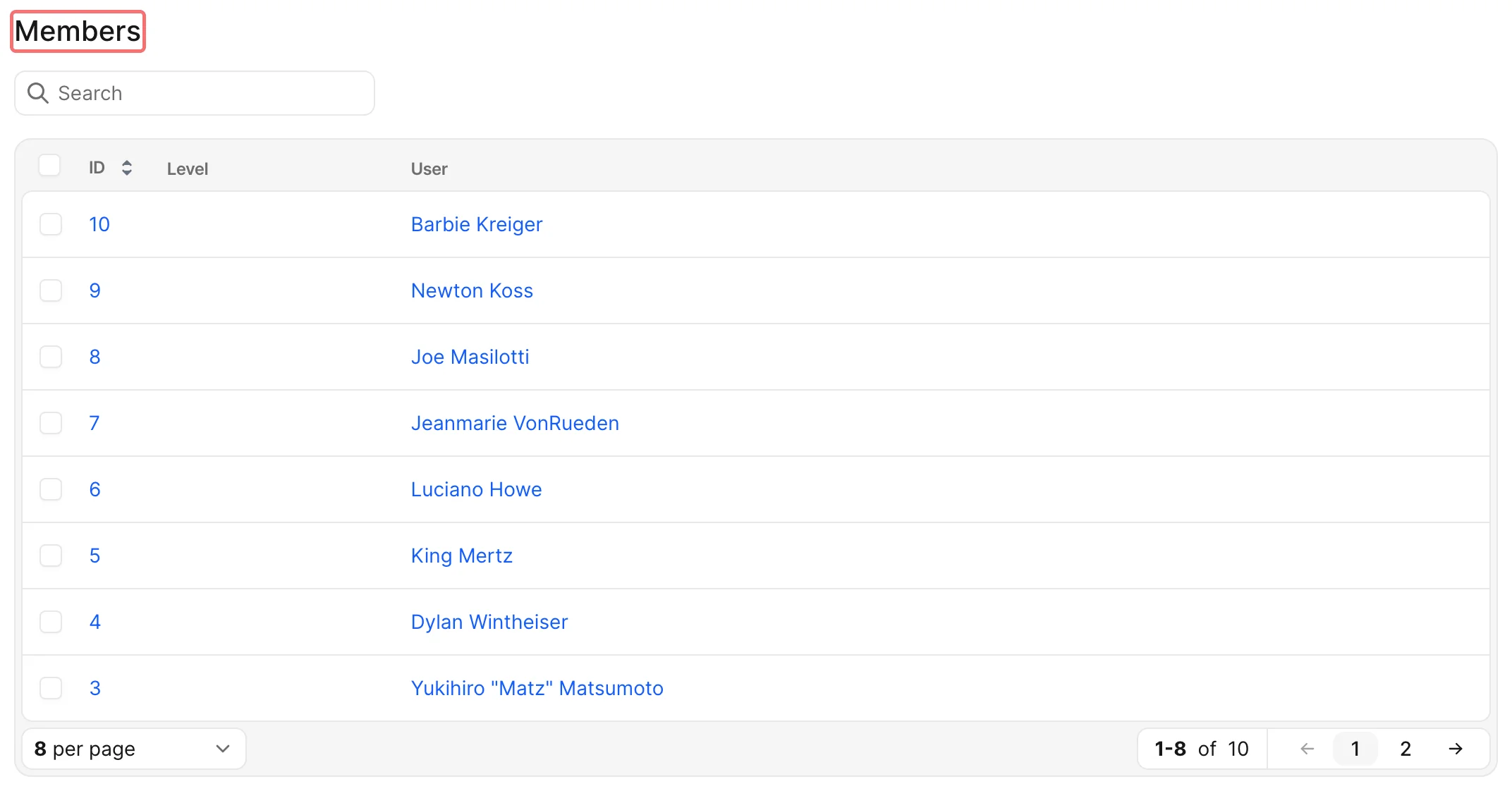
-> name
Default value
Plural association name.
Possible values
Any string or any zero arity lambda function.
Within lambda, you have access to all attributes of Avo::ExecutionContext.
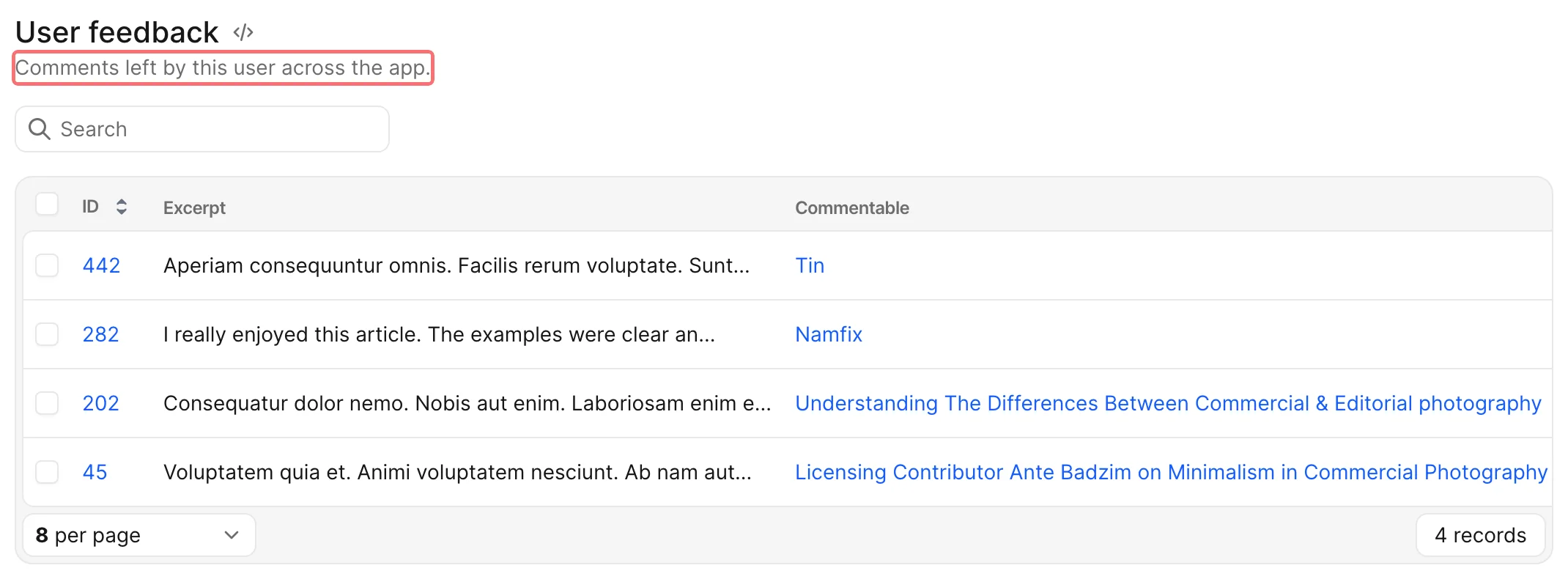
-> description
Changes the text displayed under the association name.
Default value
nil
Possible values
Any string or any zero arity lambda function.
Within lambda, you have access to query and all attributes of Avo::ExecutionContext.
Evaluated on page load, even with loading: :manual
The description lambda is evaluated to render the association header — including the placeholder shown for a loading: :manual association. So a lambda that touches the database (e.g. -> { "#{query.count} posts" }) runs on every page load, before the user clicks Load. If you reached for loading: :manual to defer that query, keep the description cheap (or omit it) — only the framed content is fetched on demand.
-> loading
Controls how the association's content frame is loaded on the Show page.
By default an association loads its content as soon as its turbo-frame is revealed (the lazy behavior). The loading option lets you defer that fetch until the user explicitly asks for it, which is useful for heavy associations you don't want to load on every page view.
The default for every association is set globally via config.associations (loading: :lazy out of the box). Set loading: on a field to override that default per association.
Possible values
| Value | Behavior |
|---|---|
:manual | Renders a placeholder with a Load button. Nothing is fetched until the user clicks it. Once opened, the frame is remembered for 15 minutes by default (see auto_load_for). |
{ mode: :manual } | Same as :manual. |
{ mode: :manual, auto_load_for: 5.minutes } | Manual with a custom sliding memory window — once opened, the frame auto-loads (no placeholder, no button) on return visits for the given duration. |
{ mode: :manual, auto_load_for: 0 } | Manual with no memory — the placeholder returns on every visit (0 or nil opts out). |
:lazy / { mode: :lazy } | Native lazy loading (loads when the frame is revealed). |
Manual loading
field :orders, as: :has_many, loading: :manualThe placeholder shows the association title, the (optional) description, and a Load button. On click, the real content is fetched into the frame. If the request fails (500, 404, network error), an inline error with a Retry button is rendered inside the frame instead of redirecting to the global failed-to-load page.
For a has_one association whose value is nil, the existing attach/create empty state is shown instead of a placeholder.
Remembering an opened frame
Once the user opens a manual frame, Avo remembers it for 15 minutes by default and skips the placeholder on return visits — the frame auto-loads directly. Pass auto_load_for to change that window:
field :orders, as: :has_many, loading: { mode: :manual, auto_load_for: 5.minutes }The window is a sliding memory, not a delay: a short-lived cookie scoped per record + frame remembers the opened frame, and every return visit within the window refreshes it. Once the window lapses, the placeholder + Load button return.
Set auto_load_for: 0 (or nil) to opt out entirely — the placeholder then returns on every visit:
field :orders, as: :has_many, loading: { mode: :manual, auto_load_for: 0 }The default window is configurable globally via config.associations.
Keep the description cheap with loading: :manual
The description lambda is evaluated to render the placeholder, before the user clicks Load — so a description that touches the database (e.g. -> { "#{query.count} orders" }) defeats the purpose of deferring the load. Branch on the loading_type attribute to skip the expensive work on the placeholder:
field :orders, as: :has_many, loading: :manual,
  description: -> { loading_type == :manual ? "Orders" : "#{query.count} orders" }
loading_type is :manual while the placeholder is shown and nil in every other render context.
-> use_resource
Sets a different resource to be used when displaying (or redirecting to) the association table.
Default value
nil. When nothing is selected, Avo infers the resource type from the reflected association.
Possible values
Avo::Resources::Post, Avo::Resources::PhotoComment, or any Avo resource class.
The value can be the actual class or a string representation of that class.
# the class
Avo::Resources::Post

# the string representation of the class
"Avo::Resources::Post"
-> attach_using
By default, non-searchable has_and_belongs_to_many attach modals use a select input.
Use attach_using: :checkbox_list to render the attach modal with a checkbox list instead. Users can select more than one record and attach them in one submit.
The attach modal uses the same option shape and row presentation as the CheckboxList field.
field :users,
  as: :{{ $frontmatter.field_type }},
  attach_using: :checkbox_list
The checkbox list respects attach_scope and the global association lookup limit. It includes inline client-side search over the records already loaded in the modal.
If the related resource defines self.search[:item], Avo uses its title, description, image_url or avatar_url, image_format, and image alt values for each row.
class Avo::Resources::User < Avo::BaseResource
  self.search = {
    item: -> do
      {
        title: record.name,
        description: record.email,
        image_url: record.avatar_url,
        image_format: :circle
      }
    end
  }
end
-> discreet_pagination
Hides the pagination details when only there's only one page for that association.
Default value
false
Possible values
true, false
-> hide_search_input
Hides the search input displayed on the association table.
Default value
false. When nothing is selected and the target resource's self.search[:query] is configured, Avo displays the search input.
Possible values
true, false.
-> hide_filter_button
Hides the filters button displayed on the association table.
Default value
false. The filters button is displayed by default and only hidden when hide_filter_button is set to true
Possible values
true, false.
-> link_to_child_resource
Sets which resource should be used in an STI scenario.
See more on this in the STI section.
Default value
false. When it's false it will use the same resource.
Possible values
true, false.
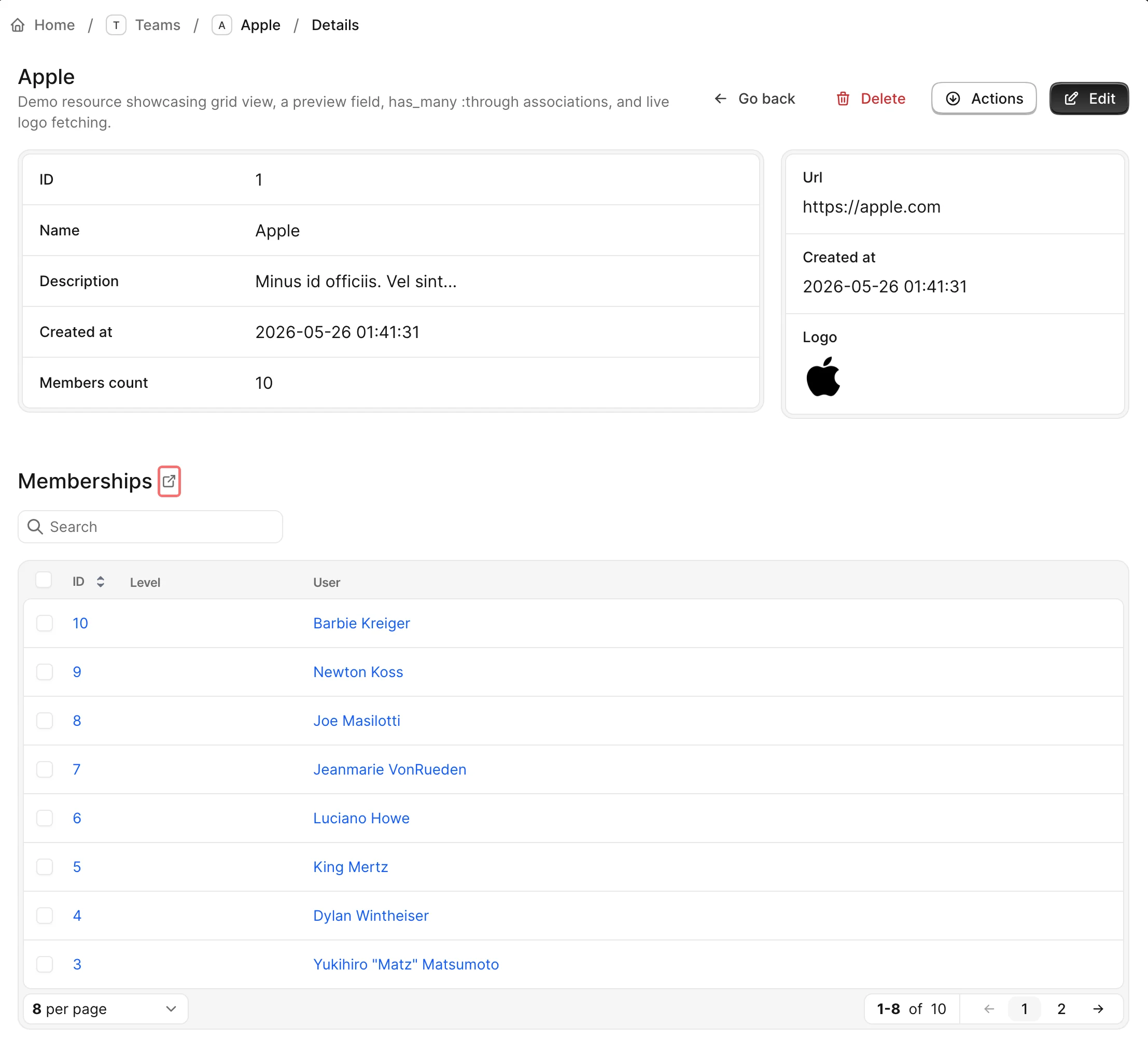
-> linkable
Use this option to make the association title clickable. That link will open a new page with the same view.
This feature doesn't go deeper than this. It just helps you see the association table easier in a separate page.
Show on edit screens
By default, the has_and_belongs_to_many field is only visible in the show view. To make it available in the edit view as well, include the show_on: :edit option. This ensures that the has_and_belongs_to_many show view component is also rendered within the edit view.
Nested in Forms
You can use "Show on edit screens" to make the has_and_belongs_to_many field available in the edit view. However, this will render it using the show view component.
To enable nested creation for the has_and_belongs_to_many field, allowing it to be created and / or edited alongside its parent record within the same form, use the nested option which is a hash with configurable option.
The avo-nested gem
Nested association forms are provided by the avo-nested gem. Add it to your Gemfile using the same private gem source as your other Avo paid gems:
gem "avo-nested", source: "https://packager.dev/avo-hq/"Run bundle install. If you have not set up packager.dev access yet, see Gem server authentication.
Keep in mind that this will display the field’s resource as it appears in the edit view.
-> nested
Enables this field as a nested form in the specified views.
Default value
{}
Possible values
A hash with the following options:
on:Views in which to enable nesting. Accepted values:limit:(Only forhas_manyandhas_and_belongs_to_manyfields) Hides the "Add" button when the specified limit is reached.
TIP
Setting nested: true is a shortcut for nested: { on: :forms }.
Example
# app/avo/resources/book.rb
class Avo::Resources::Book < Avo::BaseResource
  def fields
    # Shortcut for full nesting
    field :authors, as: :has_and_belongs_to_many, nested: true

    # Explicit nesting on new only
    field :authors, as: :has_and_belongs_to_many, nested: { on: :new }

    # Explicit nesting on edit only
    field :authors, as: :has_and_belongs_to_many, nested: { on: :edit }

    # Explicit nesting on both new and edit
    field :authors, as: :has_and_belongs_to_many, nested: { on: :forms }

    # Limit nested creation (for has_many or has_and_belongs_to_many only)
    field :authors,
      as: :has_and_belongs_to_many,
      nested: { on: [:new, :edit], limit: 2 }
  end
end
Add scopes to associations
Watch the demo videoWhen displaying has_many associations, you might want to scope out some associated records. For example, a user might have multiple comments, but on the user's Show page, you don't want to display all the comments, but only the approved ones.
# app/models/comment.rb
class Comment < ApplicationRecord
  belongs_to :user, optional: true

  scope :approved, -> { where(approved: true) }
end

# app/models/user.rb
class User < ApplicationRecord
  has_many :comments
end

# app/avo/resources/user.rb
class Avo::Resources::User < Avo::BaseResource
  def fields
    field :comments, as: :has_many, scope: -> { query.approved }
  end
end
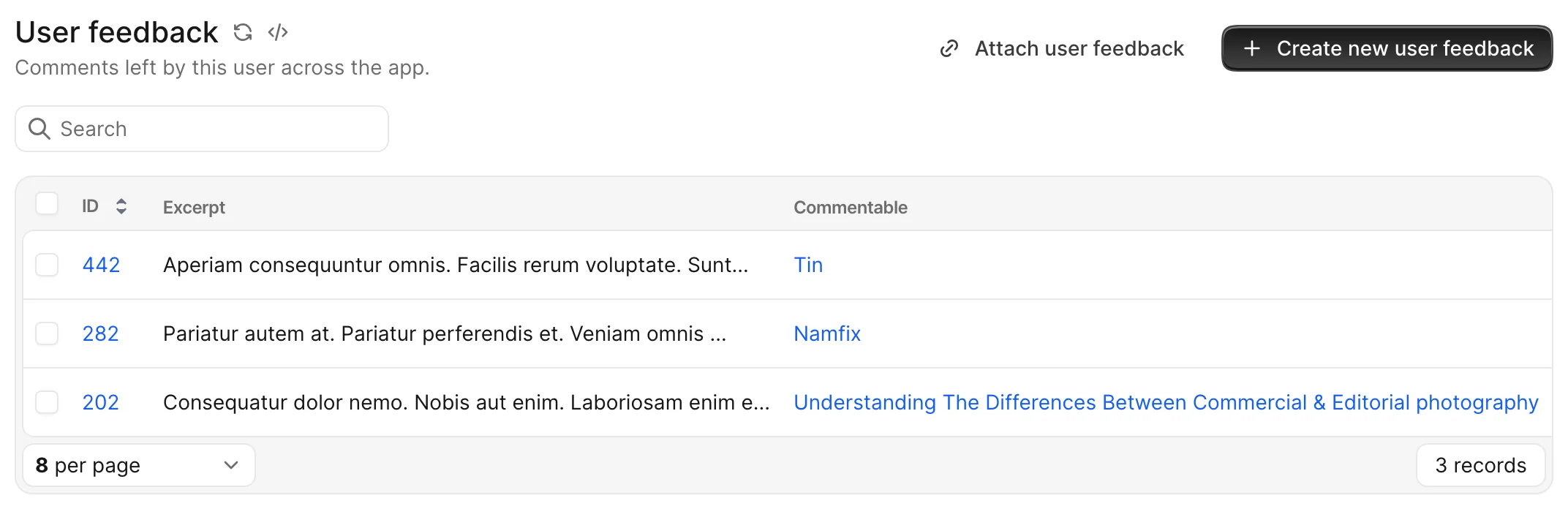
The comments query on the user Index page will have the approved scope attached.
With version 2.5.0, you'll also have access to the parent record so that you can use that to scope your associated models even better.
Starting with version 3.12, access to resource and parent_resource was additionally provided.
All the has_many associations have the attach_scope option available too.
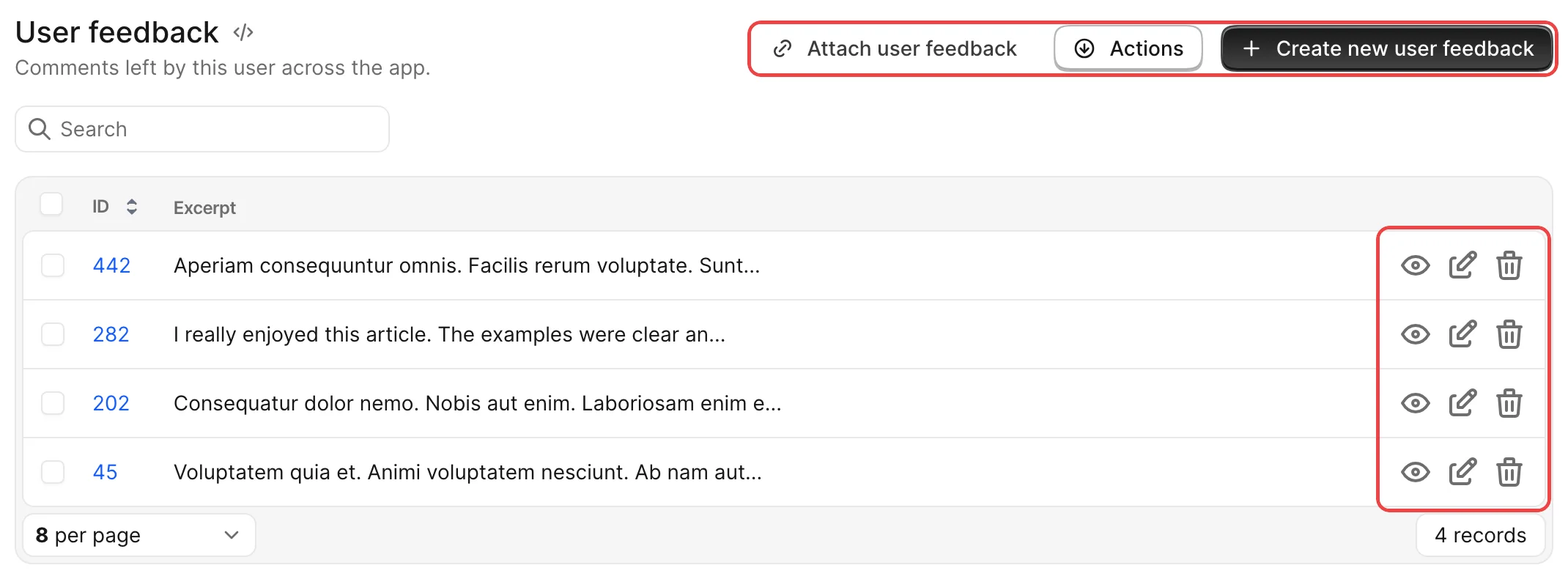
Show/hide buttons
You will want to control the visibility of the attach/detach/create/destroy/actions buttons visible throughout your app. You can use the policy methods to do that.
Find out more on the authorization page.
-> Reloadable
The reloadable option adds a reload icon next to the association title so users can easily reload just that turbo-frame instead of doing a full page reload.
Usage
To enable the reloadable feature, you have two options:
- Direct Boolean Value:
Provide a boolean value directly to the reloadable option. This sets a default behavior where the reloadable feature is either enabled or disabled based on this boolean value.
field :reviews, as: :has_and_belongs_to_many, reloadable: true- Dynamic Conditions with a Block:
For more dynamic behavior, you can provide a block to the reloadable option. Within this block, you can specify conditions under which the reloadable should be displayed.
field :reviews, as: :has_and_belongs_to_many,
  reloadable: -> {
    current_user.is_admin?
  }
In the above example, the reloadable will be visible if the current_user is an admin.
ExecutionContext
The reloadable block executes within the ExecutionContext, granting access to all default methods and attributes.

-> for_attribute
The for_attribute option allows to specify the association used for a certain field. This option make possible to define same association with different scopes and different name several times on the same resource.
Usage
field :reviews,
  as: :has_and_belongs_to_many

field :special_reviews,
  as: :has_and_belongs_to_many,
  for_attribute: :reviews,
  scope: -> { query.special_reviews }